The tools we make · 12 min read
Perfect homework, poor exam
Some teachers are rethinking homework because AI can do it in seconds. We followed the question underneath.
The questionWhat is homework for, now that a machine can do it?
5 notes from the making of this piece, before it was published: where we were wrong, what we cut, what we checked. Real corrections made after publication go on the Corrections page. Switch off for a clean read.
How to read the colours
Tap a colour to read only those, one after another.
In Fullerton, California, a maths teacher tells his students something teachers did not used to say. He is “not going to pretend like you aren’t” using AI.1
He is not alone. In July 2026, The 74 reported that teachers across the United States were rethinking, scaling back or, in some cases, dropping homework, because AI can finish it in seconds.1 The story reached us in September through local news sites.
The notes in the margin are the journey: where we got something wrong, checked, cut or rewrote. Facts carry numbered sources. My own views are marked as mine. Where nobody knows, I say so.
The shortcut itself is old. In a survey of about 30,000 American high schoolers, a third said they had copied someone’s homework, and a third had used AI as an unauthorised aid.1 What is new is that it is now free and instant. In a Pew survey fielded in autumn 2025, 54% of American teens had used AI chatbots for schoolwork, and one in ten did all or most of it that way.2
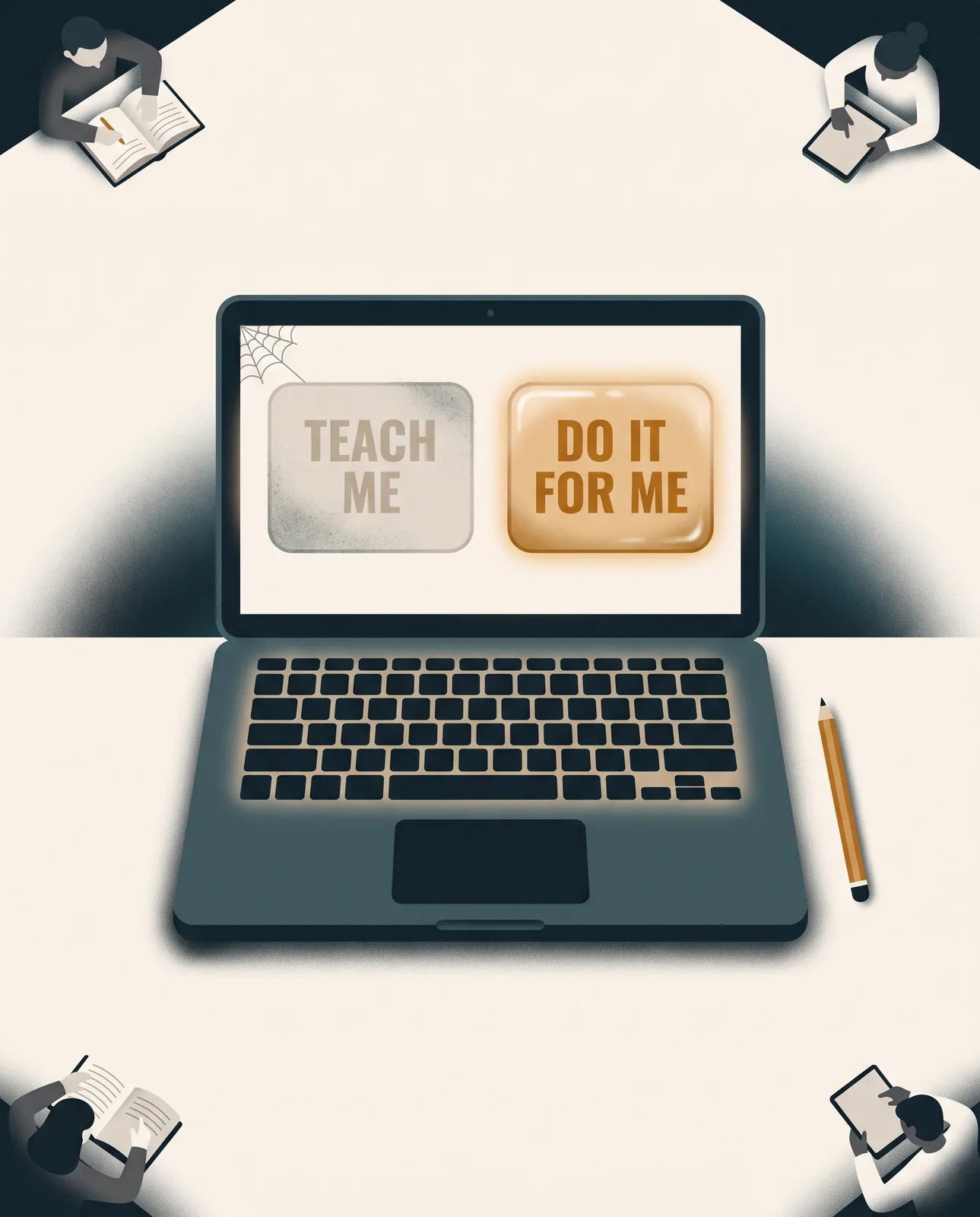
The companies have an answer: a “teach me” mode that asks questions instead of handing over answers. Anthropic, OpenAI and Google each launched one in 2025.456 All are optional. Justin Reich of MIT put the problem in one line: the “carefully teach me this stuff” button sits right next to the “do everything for me” button.1
The young people notice: in one survey of 12 to 29 year olds, 67% now think AI harms their critical thinking, up from 54% earlier in 2025, even as their use rose.3
In early September 2026, New York City and Los Angeles restricted student use of generative AI for the year.7 I do not know if they are right. Nobody does yet.
What was homework for?
Before the machine, a smaller question: what is homework?
Some of it is practice. Some asks you to learn alone before class. Some asks you to gather facts for a report. In my view, what they share is that you learn by doing: you think, you try, you get it wrong. The paper you hand in is evidence that this happened. It is not the point.
In 1916 John Dewey wrote that the schools that worked gave pupils “something to do, not something to learn”, and that “learning naturally results”.8
Does homework even work? The best-known review (2006) found a clearer link with achievement in the upper grades than in the early ones, and no sign that more is better.9 A study of more than 7,000 Spanish teenagers found that, among things a student does, the best predictor of a payoff was neither time nor effort. It was autonomy: doing it yourself. (Prior knowledge mattered most of all.)10 That is the one thing an AI answer takes away.
The worry is also older than AI. In January 1900 the Ladies’ Home Journal ran an article calling homework “a national crime”.11 Its author, the editor Edward Bok, also asked whether a child helped by a parent might come to depend on others.11 That is the AI worry with a parent in the machine’s place.
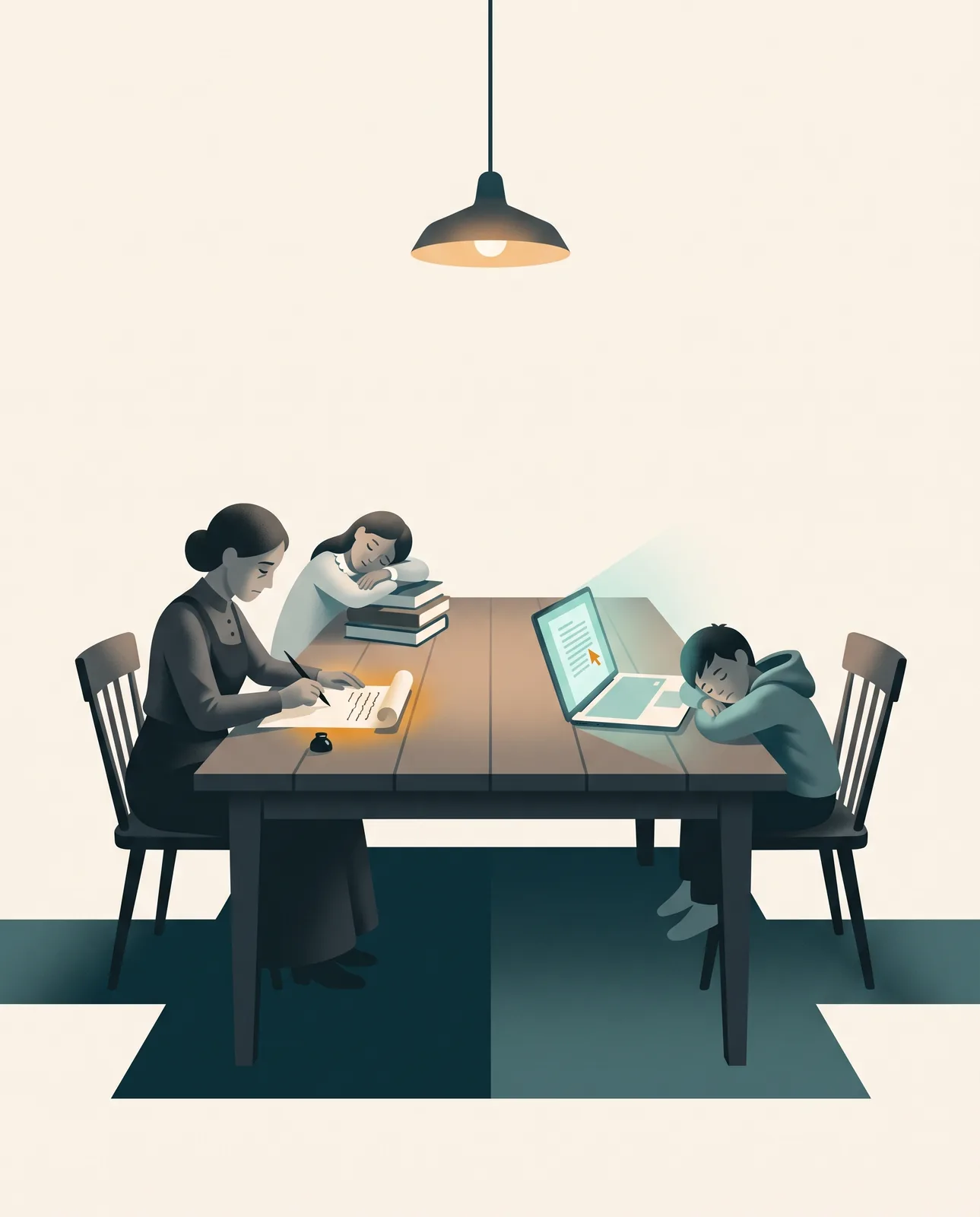
Perfect homework, poor exam
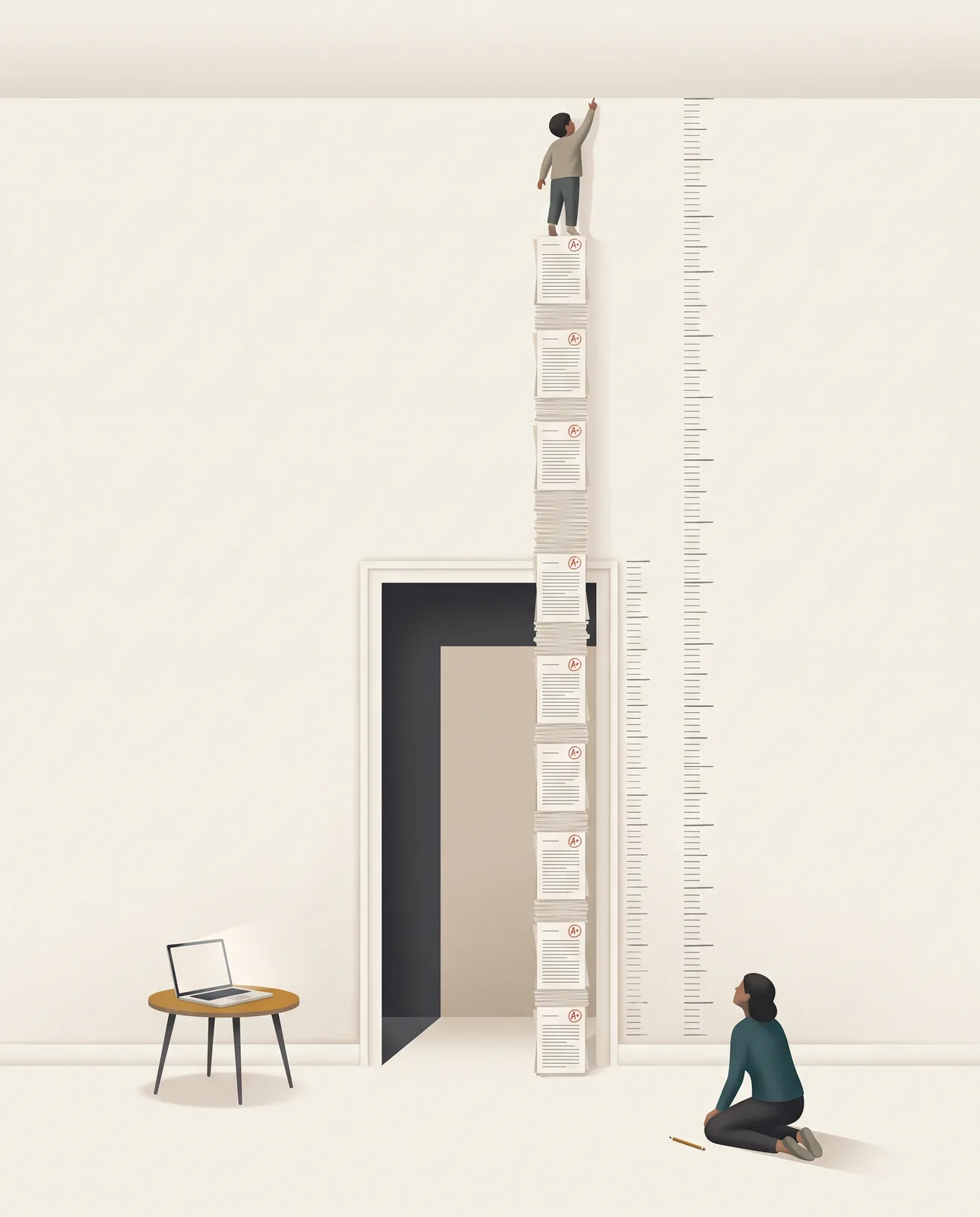
Here is the danger. If the paper is only evidence, the evidence can now be made without the thing it is evidence of. That is no longer only a worry. It has been measured, in two large studies.
In Turkey, Hamsa Bastani and colleagues gave about a thousand high-school maths students GPT-4 while they practised. With an ordinary chat window, practice scores rose 48%. Then came an exam with no AI. Students who had practised with the open chatbot scored 17% lower than students who never had it.12 A second group got a tutor version that gave hints instead of answers. Their practice scores rose 127%, and on the exam they did no worse than students without AI.12
In China, a larger study followed 26,811 students for thirty months. When they took up generative AI, homework scores rose 18%, and within six months their monthly exam scores fell by about 20%.13 Two cautions. It is a working paper, not yet peer reviewed, and it compares students before and after, not at random. The losses were concentrated among students who outsourced their homework, about 80% of users.13
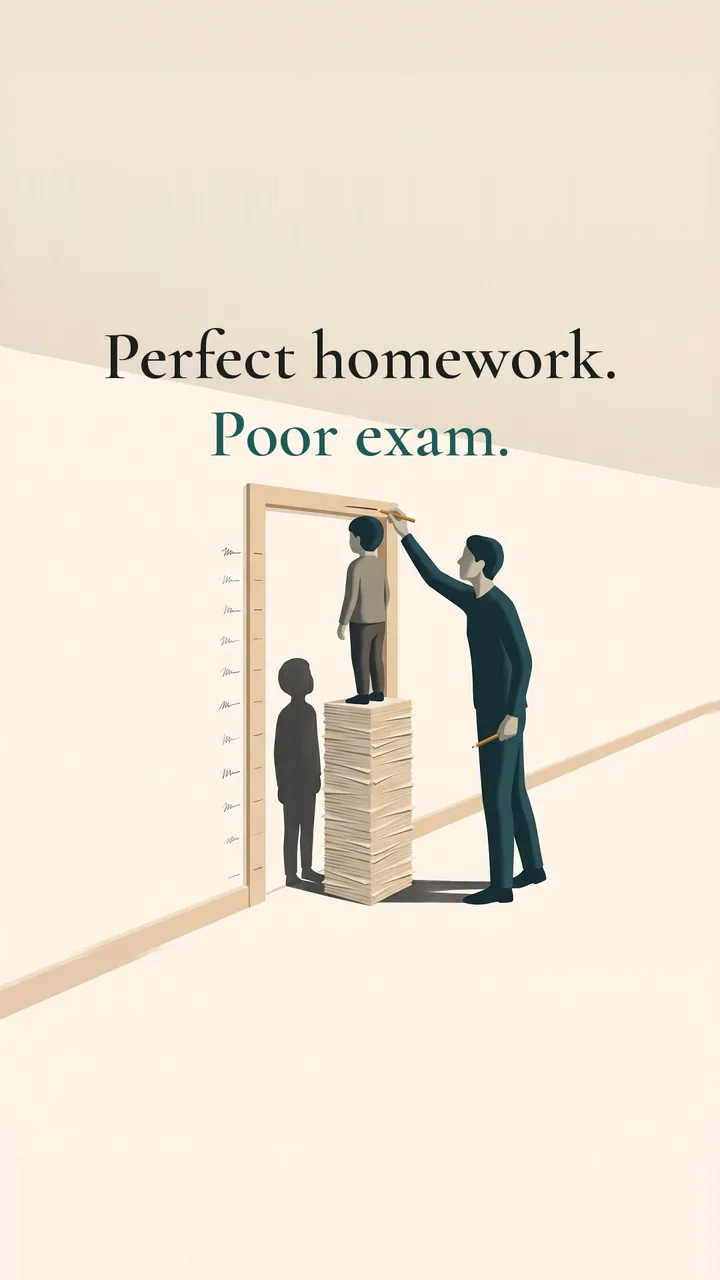
When I first talked this through, I described it from the teacher’s side: the homework is perfect, but the exam does not look good. “Then it actually shows who…”14 I did not know two large studies, in two different countries, had found something very close.
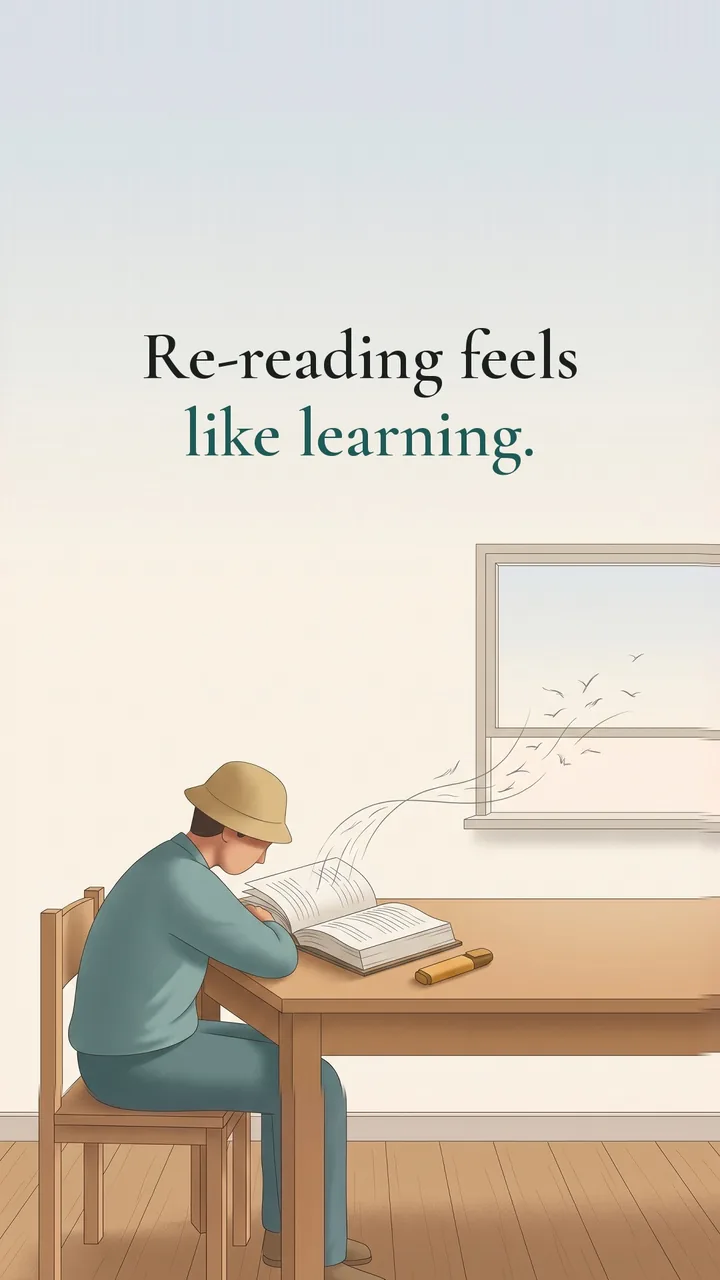
Why does nobody notice from the inside? Because fluent work feels like learning. In a 2006 experiment, students either re-read a text four times, or read it once and tested themselves three times. A week later the self-testers remembered 61% and the re-readers 40%, yet the re-readers had predicted they would remember more.15 Performance gains are not learning, as researchers now say about AI.16
The oldest version of this gap is about 2,400 years old. In Plato’s Phaedrus, an Egyptian king refuses the gift of writing: students will have “the show of wisdom without the reality”.17 Note who says it: a king, in a tale, told by Socrates, written down by Plato.
Same tool, opposite results
The same AI helped some students and hurt others. So what decides it?
Picture three students given the same project and the same AI. The first uses it to learn. The second already knows how, and gets the whole project in one go. The third says “just complete it for me.”14 The teacher receives three good projects. Inside three students, three different things happened.
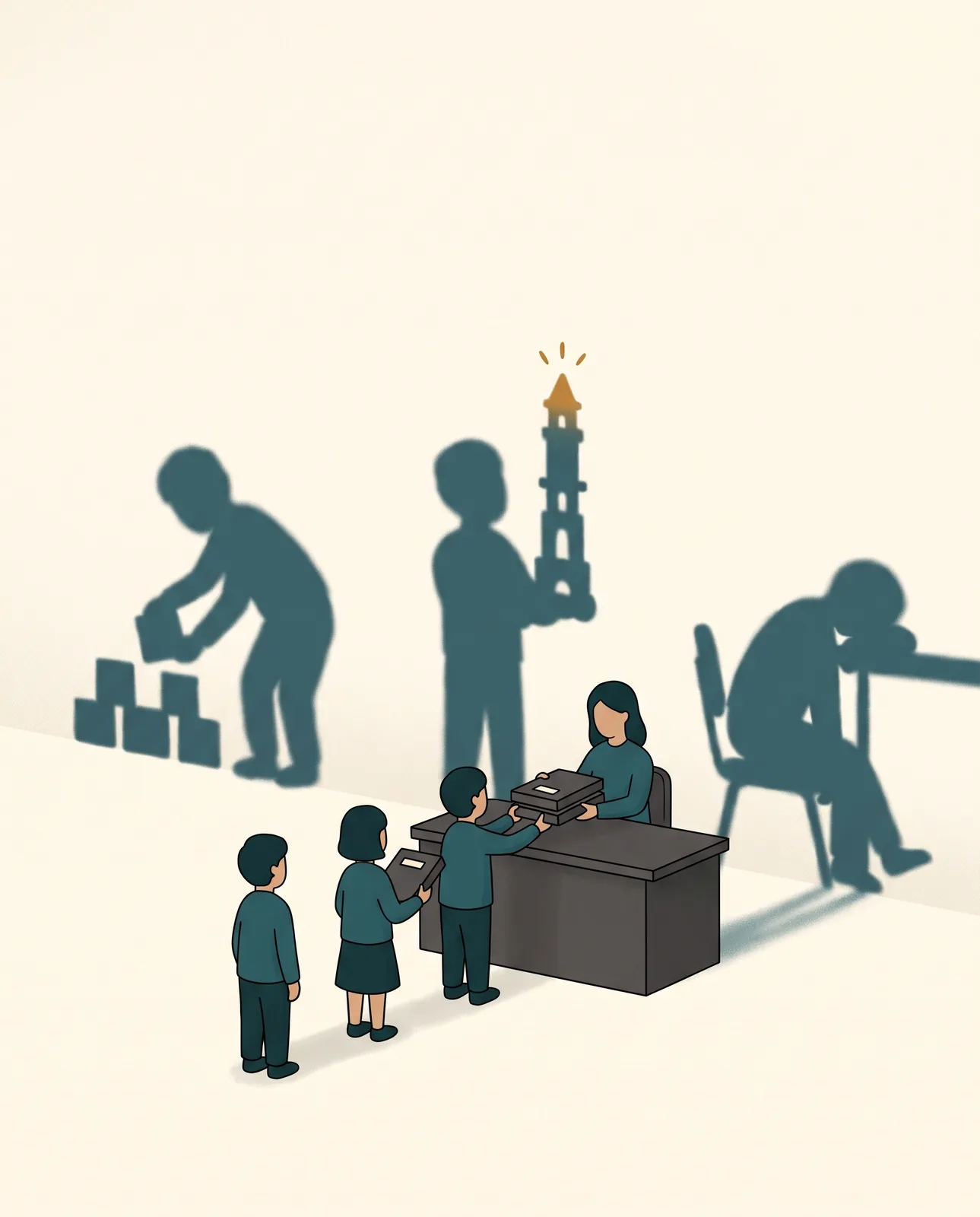
My first instinct was simple. It isn’t about the tool. It isn’t only the tool. It is whether the student has a heart to learn, or just wants to finish.
Where I stand now: I think adults grow that heart, partly by designing work where thinking is the only way through, though students’ own habits matter too.
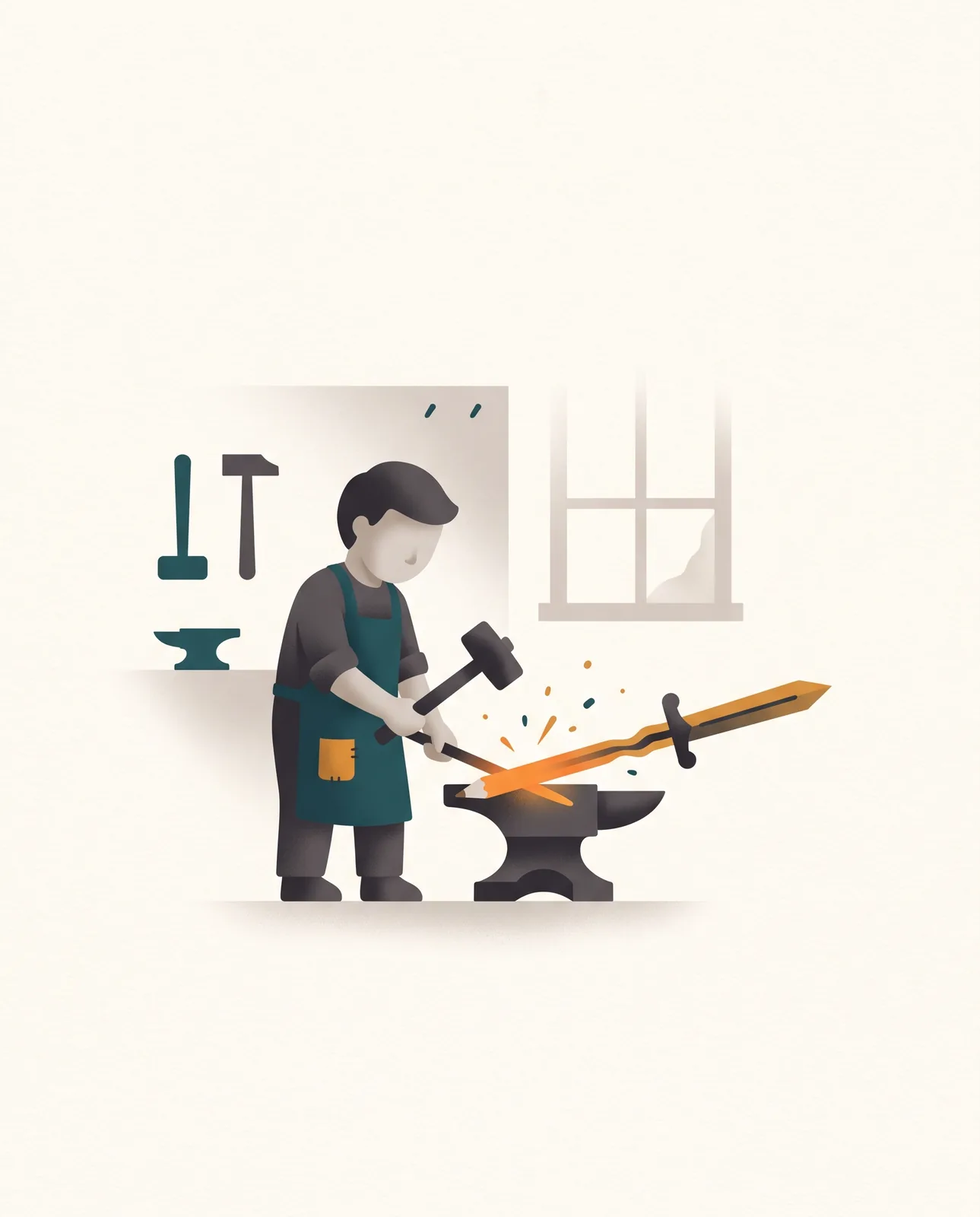
I began this story with an image of my own: “People suffer then they grow just like the steel is being heated in order to smash and become sword.”14 But not all heat forges. Some just burns. Difficulty helps only when the learner can respond to it, which Robert and Elizabeth Bjork call desirable difficulty.18 What builds a mind is making an answer and pulling it back out of memory, called retrieval practice. A related finding, the generation effect, is that what you produce yourself is remembered better than what you only read; a 2007 meta-analysis found it across 86 studies.19 Struggle is not sacred; useful difficulty is.
The other side deserves its best version. In a 2025 Harvard trial of 194 physics students, a tutor designed around good teaching beat an active-learning class, in less time, in one course.20 But the big claims shrink when you look closely. A study of more than 6,000 middle-schoolers found a small, borderline gain on one practised question (p = 0.065), which its authors called “not transformational”.21 My reading: the case for AI in learning is strongest exactly where it is designed not to do the work. That supports this piece.
How would a teacher know?
If the paper looks the same either way, how would a teacher know?
Not with a detector. In a 2023 study, seven popular AI detectors flagged, on average, 61% of essays by non-native English speakers as AI-written.22 Australia’s higher-education regulator wrote in 2025 that reliably detecting AI use “is, at this point, all but impossible”.23
The signal already exists: the exam. Across a class, strong homework next to weak exams is the gap both studies measured. For one student it is a reason to ask, not proof. The other signal is to ask plainly. My version is five questions: What did you do? Why this way? What if I change one thing? Where could it be wrong? What would you ask next? A student who did the work can say why.
But it costs time. Published university practice puts a short oral check at 10 to 15 minutes per student.24 For one class of 30, that is five to seven and a half hours, about the 5.9 hours a week that teachers who use AI weekly report saving.25 A secondary-school teacher with five classes would need five times that.
It might have to be sampled: a few students, a cold question, the exam you already give. One university, Sydney, splits assessment into two lanes: secure checks where learning must be shown, and open tasks where AI is allowed and taught.26
Why not just ban it? A 2025 study compared 20 English secondary schools with restrictive phone policies and 10 without, among 1,227 pupils. The restrictions cut phone use during the school day, but the study found no difference in wellbeing, and its commentary notes none in sleep or exam results.27 It was observational, not a trial, and only about one pupil in ten took part, so it settles little. It suggests, at most, that a rule at school changes the school day, not necessarily the habit. Check the learning, not the paper.
Who can change school?
A good check needs a school willing to adopt it. Schools were not built to change quickly.
I said it bluntly at first: the education system was designed to make people obey mass schooling was born partly as a tool of order. The political scientist Agustina Paglayan argues from data that states built primary schools mostly out of elites’ fear of the masses, often after unrest.28 Her critics say she underplays how teachers and students resisted, and literacy and citizenship were also goals of mass schooling.29
I think change starts where schools are free to try: a teacher can pitch to a board, check the research and run a pilot.
The learning modes in the companies’ products are optional, so a student can switch them off.5 I think the real question is who holds the switch. By a lock I mean the rule that says, task by task, how much AI is allowed. My view is that the lock belongs on the assignment, not on the tool: the teacher sets it, and checks the learning where it matters. That only works in a school willing to adopt it, which is why the history above matters.
What should stay inside a person?
If a machine can do the task, what should school leave inside a person?
In my view, education is to survive, to grow through the friction of society, and to find your own path.
Here the research pushed back on me. I used to think a map of how things connect could stand in for stored knowledge. The cognitive scientist Daniel Willingham argues that you can only think critically about what you know.30 In a study of baseball, weak readers who knew the game understood a passage about it better than strong readers who did not.31 So you need enough connected knowledge in each area to notice when an answer is wrong. With thin knowledge and a fluent, confident AI, you will not notice.
How much is enough?
I don’t know.
Is any skill sacred? I do not think there is a limit: AI may come to do almost everything we can. We do not know. But that does not settle what a child should practise today. The calculator is the precedent: the research backed using calculators alongside ordinary maths teaching, not instead of it.32 Keep the tool, protect the core skill. What to protect is decided per goal, for now.
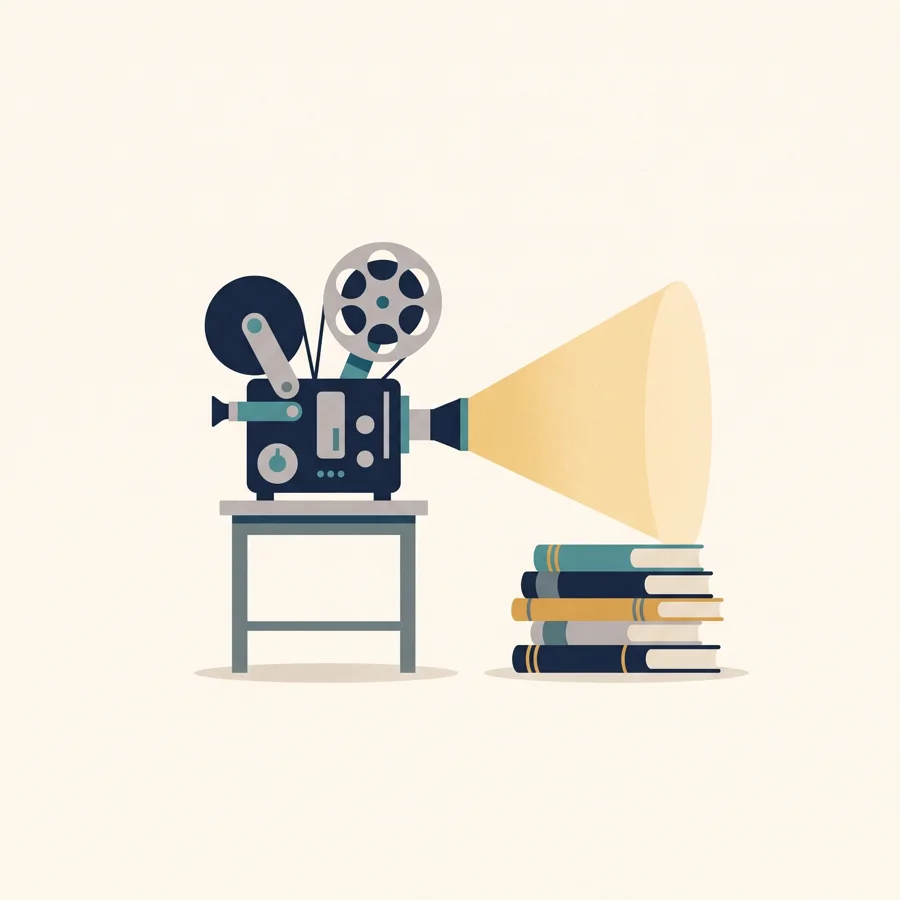
Promises about classroom technology have a long record. In 1913, Thomas Edison predicted: “Books will soon be obsolete in the public schools.”33
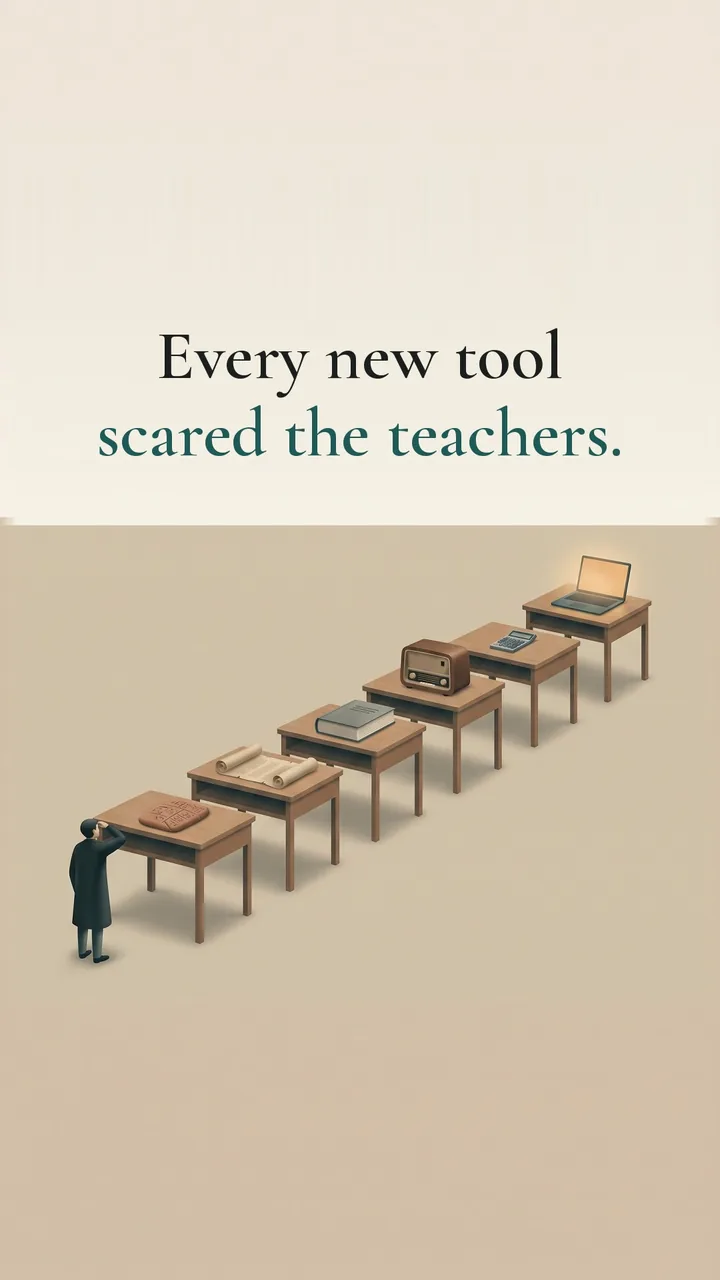
The old fear also breaks. Socrates’ deeper objection to writing was that a text keeps “a solemn silence” when you question it.17 AI answers back, fluently, and sometimes wrongly. A calculator does one checkable step; AI can do the whole task. So history does not tell us we will be fine. My reading is that it went best where people redesigned teaching on purpose.
Where this does not fit yet: in Thailand I found no national data on how students use AI for homework. A 2026 survey of 1,777 students found that 94% had used AI to help with their studies. It was not a random sample, so it shows a pattern, not a rate.34 Young children are different: Common Sense Media advises that children under five use no AI chatbots at all.35 For some students with learning differences, AI may be an accommodation, not a shortcut. The evidence is early.36
Where I have landed
Here is what I believe now. A finished assignment no longer proves that a child learned. The answer is not to police the tool. It is to check the learning, in class, and to design work where thinking is the only way through.
I will not claim that AI rots the brain: the study behind that headline had 54 people and is still an unreviewed preprint.37 I will not claim that AI tutors double learning, or that I know how much knowledge is enough.
I changed my mind three times along the way. I started with the forge: struggle makes us. I now think useful difficulty does. I thought a map of how things connect could stand in for knowledge. It cannot. And I thought it was not about the tool. It is partly about the tool.
Two things I will be watching: whether the New York and Los Angeles restrictions last the year, and whether any school publishes what happened when it replaced homework with in-class checks.
AI can do the homework. Nobody can do the learning for you.
So what should we leave inside a child, now that the answers are free? I do not know yet.
Keep this for the next time someone shows you a perfect piece of work. Ask them how they made it.
How this was made. I talked this story through out loud, in a long conversation. Most of it was lost: 23 of its 133 turns survive word for word, and the rest were rebuilt in the way I think and ask, and confirmed as mine on 7 October 2026. We used tools from Anthropic and OpenAI in the research, and both companies’ learning modes appear above, so we have tried to describe them no more kindly than Google’s. Sources were checked on 1 and 6 October 2026. We will get some things wrong. When we do, we correct them in public.
How this was madeThe conversation behind this story was mostly lost, then rebuilt and confirmed by the author. How we make this
Sources
Every number, name, date and quote above points to one of these. If one does not say what we said it says, tell us.
- 1Greg Toppo, "The End of Homework? Teachers Grapple With Cheating in the Age of AI", The 74, 14 July 2026. Includes the Challenge Success survey figures and the remarks of Al Rabanera and Justin Reich. Open the source
- 2Pew Research Center, teens and AI chatbots survey, 24 February 2026 (n=1,458). Open the source
- 3RAND American Youth Panel (ages 12 to 29), 2025 surveys, as reported by eSchool News, 25 March 2026. Open the source
- 4Anthropic, "Introducing Claude for Education" (learning mode), 2 April 2025. Open the source
- 5OpenAI, ChatGPT study mode, launched 29 July 2025; MIT Technology Review, 29 July 2025 (quotes OpenAI's Leah Belsky). Open the source
- 6Google, "Guided Learning" in Gemini, announced 6 August 2025. Open the source
- 7TechPolicy.Press, 5 September 2026, and Stateline, 9 September 2026, on the New York City and Los Angeles restrictions on student generative AI use. Open the source
- 8John Dewey, Democracy and Education (1916), chapter XII, "Thinking in Education". Project Gutenberg #852. Open the source
- 9Harris Cooper, Jorgianne Civey Robinson and Erika Patall, "Does Homework Improve Academic Achievement? A Synthesis of Research, 1987 to 2003", Review of Educational Research 76(1), 2006. Open the source
- 10Rubén Fernández-Alonso, Javier Suárez-Álvarez and José Muñiz, "Adolescents' homework performance in mathematics and science", Journal of Educational Psychology 107(4), 2015. Open the source
- 11Edward Bok, "A National Crime at the Feet of American Parents", Ladies' Home Journal, January 1900 (Internet Archive scan). Open the source
- 12Hamsa Bastani et al., "Generative AI without guardrails can harm learning", PNAS 122(26), 2025. Open the source
- 13David Strömberg, Victor Lei and Yanhui Wu, CEPR Discussion Paper DP21577, 2026, on generative AI, homework and exam performance among 26,811 Chinese students. A working paper, not peer reviewed. Open the source
- 14The author's own words, from his notes of 27 and 30 September 2026.
- 15Henry L. Roediger III and Jeffrey D. Karpicke, "Test-Enhanced Learning", Psychological Science 17(3), 2006. Open the source
- 16Lixiang Yan, Samuel Greiff, Jason Lodge and Dragan Gašević, "Distinguishing performance gains from learning when using generative AI", Nature Reviews Psychology, 2025. Open the source
- 17Plato, Phaedrus 274e to 275e, trans. Benjamin Jowett. Project Gutenberg #1636. Open the source
- 18Elizabeth L. Bjork and Robert A. Bjork, "Making things hard on yourself, but in a good way: Creating desirable difficulties to enhance learning", 2011. Open the source
- 19Sharon Bertsch et al., "The generation effect: A meta-analytic review", Memory & Cognition 35(2), 2007 (86 studies). Open the source
- 20Gregory Kestin et al., "AI tutoring outperforms in-class active learning", Scientific Reports 15, 2025 (n=194; one course; the tutor was custom-built). Open the source
- 21Philip Oreopoulos et al., "Making AI Tutoring Productive", NBER Working Paper w35621, August 2026. Open the source
- 22Weixin Liang et al., "GPT detectors are biased against non-native English writers", Patterns 4(7), 2023 (average false-positive rate 61.22% on TOEFL essays). Open the source
- 23TEQSA (Tertiary Education Quality and Standards Agency, Australia), report on assessment reform in a time of artificial intelligence, September 2025, p. 2. Open the source
- 24Gordon Joughin, A short guide to oral assessment (2010); University of Sydney and Griffith University guidance on interactive oral assessment (not opened for this story). Open the source
- 25Gallup and the Walton Family Foundation, survey of US teachers' use of AI, 2025 (self-reported time saved by weekly users: 5.9 hours a week). Open the source
- 26Danny Liu and Adam Bridgeman, "What to do about assessments if we can't out-design or out-run AI?", University of Sydney, 8 December 2023. Open the source
- 27Victoria Goodyear et al., school phone policies (SMART Schools study), The Lancet Regional Health Europe, 2025, with the accompanying Lancet commentary. A cross-sectional observational study of 30 English secondary schools (about 10% of pupils responded, per the commentary). Open the source
- 28Agustina S. Paglayan, Raised to Obey: The Rise and Spread of Mass Education (Princeton University Press, 2024). Open the source
- 29Review of Raised to Obey by Matus, Review of Democracy, 21 November 2025. Open the source
- 30Daniel T. Willingham, "Critical Thinking: Why Is It So Hard to Teach?", American Educator, Summer 2007. Open the source
- 31Donna R. Recht and Lauren Leslie, "Effect of prior knowledge on good and poor readers' memory of text", Journal of Educational Psychology 80(1), 1988. Open the source
- 32Ray Hembree and Donald J. Dessart, "Effects of hand-held calculators in precollege mathematics education: A meta-analysis", Journal for Research in Mathematics Education 17(2), 1986. Open the source
- 33Thomas Edison, interview in the New York Dramatic Mirror, 9 July 1913, as verified by Quote Investigator. No public link confirmed.
- 34Rocket Media Lab and p2h Foundation, survey of 1,777 Thai secondary and vocational students on AI use (2026), reported by The Matter, 3 June 2026. Not a random sample. Open the source
- 35Common Sense Media, risk assessment of Google Gemini Under 13 and Gemini with teen protections, 5 September 2025. The age advice (no AI chatbots for children under 5) is on the Gemini Under 13 page. Open the source
- 36Scottish Qualifications Authority, review of AI and additional support needs, March 2025. Open the source
- 37Nataliya Kosmyna et al., "Your Brain on ChatGPT", MIT Media Lab preprint, 2025 (54 participants; still under review as of early October 2026). Open the source
Words, people and ideas
Every dotted word in the story opens a card. Here they all are, in one place.
Person Justin Reich
Justin Reich is a researcher at MIT, quoted in The 74's July 2026 report on teachers giving up on homework. He put the problem with school AI in one line: the "carefully teach me this stuff" button sits directly next to the "do everything for me" button. We quote him because he named the tension in a few words. Read more
Work Hamsa Bastani and colleagues
A field experiment published in PNAS in 2025. About 1,000 high-school maths students in Turkey practised with GPT-4, either in an ordinary chat or in a tutor version built to give hints instead of answers. Both groups practised better. When the exam came with no AI, only the tutor group did as well as students who had never had it. Read more
Word working paper
A working paper, or preprint, is a study shared publicly before other scientists have reviewed it. It can be careful and still turn out wrong. Several studies in this story, including the 26,811-student China study and the 54-person brain-activity study near the end, are at this stage. We say so each time, and treat their numbers as signs, not settled facts.
Person Edward Bok
Edward Bok edited the Ladies' Home Journal, a popular American magazine. In January 1900 it ran "A National Crime at the Feet of American Parents", which attacked homework. In it he asked whether a child helped by a parent might grow into a person who depends on others. It is the 1900 version of today's worry. Read more
Person John Dewey
John Dewey was an American philosopher who spent his career on how children learn. In Democracy and Education (1916) he wrote that the schools that work give pupils something to do, not something to learn, and that learning follows when the doing demands thinking. Teachers still quote him for the idea of learning by doing. Read more
Work Plato's Phaedrus
A dialogue by Plato, written about 2,400 years ago. Near the end Socrates tells a story: an Egyptian king, Thamus, is offered the invention of writing and refuses it, warning that it will give students "the show of wisdom without the reality". Notice the layers: a king, in a tale, told by Socrates, written down by Plato. We use Benjamin Jowett's translation. Read more
Person Thomas Edison
The American inventor told a New York newspaper in 1913 that books would soon be obsolete in the public schools, because every branch of knowledge could be taught with the motion picture. Books are still here. He is a reminder that promises about classroom technology have a long record of running ahead of what happened.
Idea retrieval
Retrieval practice means pulling something out of memory instead of looking at it again: closing the book and trying to recall it, or testing yourself. In a 2006 experiment, students who tested themselves remembered more a week later than students who re-read, although the re-readers expected the opposite. It feels harder, and it works better. Read more
Idea desirable difficulty
A term from the memory researchers Robert and Elizabeth Bjork. Some difficulty, such as spacing practice out or testing yourself, makes learning last. Other difficulty only frustrates. The test is whether the learner can respond to it. It is the research version of an old image: not all heat forges steel, and some just burns it. Read more
Work a study of baseball
A 1988 study by Donna Recht and Lauren Leslie. They gave 64 seventh- and eighth-graders a passage about a made-up baseball game and tested what they remembered. Knowing baseball predicted understanding better than general reading skill did: weak readers who knew the game beat strong readers who did not. It is small, but it is the classic case for "you need to know things to think about them". Read more
Person Agustina Paglayan
A political scientist. Her 2024 book Raised to Obey argues, from data across many countries, that states built mass primary schools mostly out of elites' fear of the masses, often after unrest. Critics say she underplays how teachers and students resisted, and literacy and citizenship were also goals of mass schooling. Read more
Word AI detectors
Programs that claim to tell whether a text was written by an AI. In a 2023 test, seven popular ones flagged on average 61% of essays by non-native English speakers as AI-written. Australia's higher-education regulator says reliable detection is "all but impossible". Read more
Idea two lanes
An approach set out by the University of Sydney in December 2023. In secure lanes, done under supervision, students must show what they can do without AI. In open lanes, AI use is allowed and taught. The point is to stop guessing who wrote which paper, and to decide in advance where the proof will happen. Read more